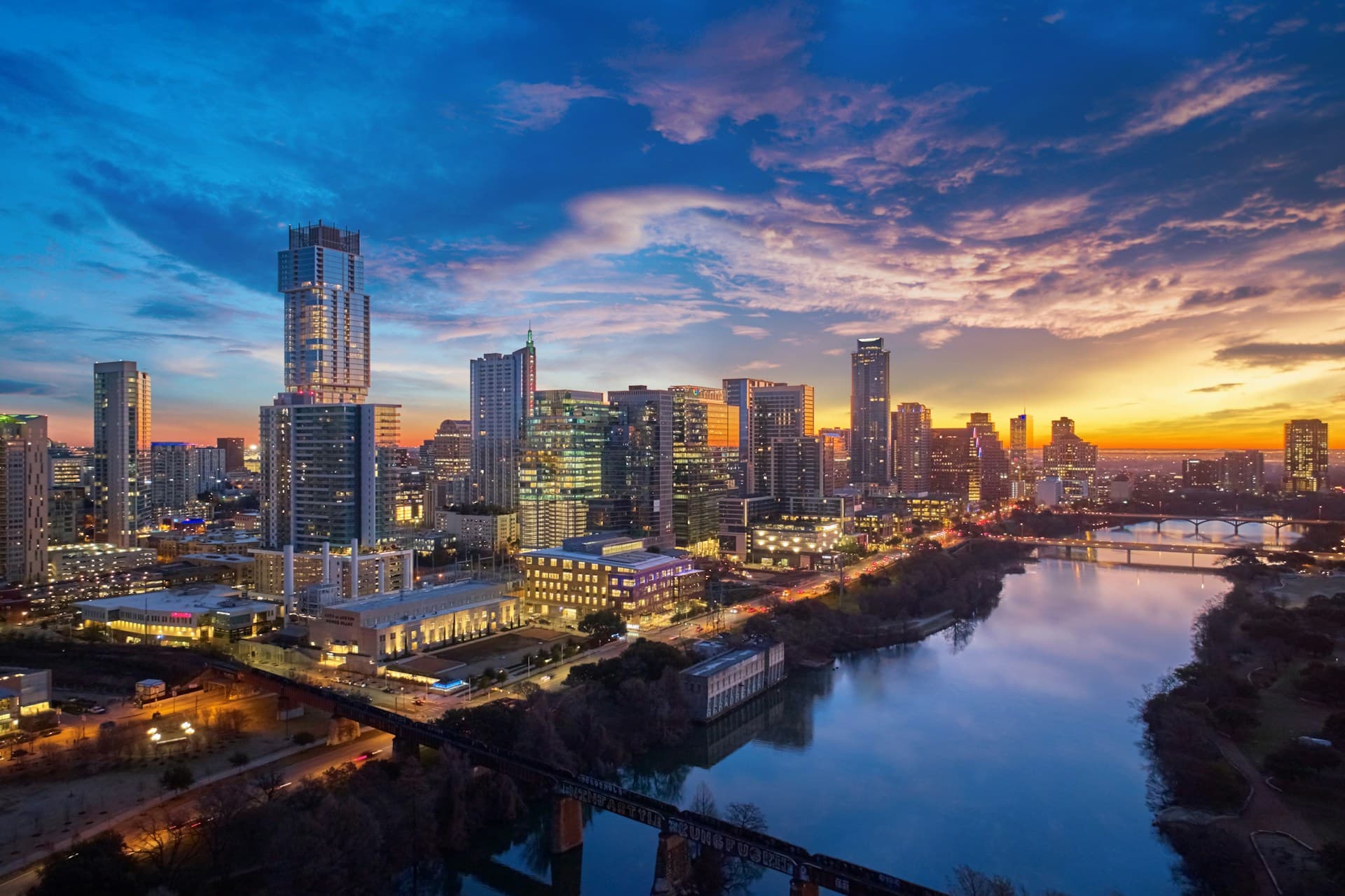
Austin has a history as vibrant as its music scene. From its founding as the capital of the Republic of Texas to its evolution into a global tech hub and cultural destination, this Hill Country city has witnessed nearly 200 years of remarkable growth. Today, its historic landmarks and forward-thinking spirit stand as testament to the generations who shaped this unique community.
Early History & Founding
Long before European settlers arrived, the area around present-day Austin was home to Tonkawa, Comanche, and Lipan Apache peoples who lived along the banks of the Colorado River. Spanish missionaries and explorers traversed the region in the 18th century, but permanent settlement came later.
In 1839, Mirabeau B. Lamar, President of the Republic of Texas, selected the site of a small settlement called Waterloo as the new capital. Renamed Austin in honor of Stephen F. Austin, the “Father of Texas,” the city was designed from the start to be a seat of government, with the original Capitol building and grid of streets laid out along the Colorado River.
Capital of the Republic & Statehood
As the capital of the Republic of Texas and later the state, Austin grew steadily through the mid-1800s. The arrival of the Houston and Texas Central Railway in 1871 connected Austin to the broader economy and spurred growth in commerce, agriculture, and education.
The current Texas State Capitol, completed in 1888, became a defining landmark. Built from distinctive sunset-red granite quarried in Marble Falls, it stands taller than the U.S. Capitol and remains one of the most recognizable buildings in the state.
Austin's Notable Landmarks
Austin is home to numerous historic and cultural landmarks, including the Texas State Capitol, the Driskill Hotel (1886), Moonlight Towers (1895), the Paramount Theatre (1915), and the University of Texas Tower (1937). These sites represent the city's rich architectural and cultural heritage.
The University of Texas (1883)
The founding of the University of Texas at Austin in 1883 proved transformative for the city. The university brought a steady influx of students, faculty, and intellectual energy that shaped Austin's identity as a center of learning and innovation.
The discovery of oil on university-owned lands in West Texas in 1923 created the Permanent University Fund, providing resources that helped build UT into one of the nation's premier public research universities. Today, UT Austin is one of the city's largest employers and a driving force behind its tech and startup ecosystem.
The Dam Era & Highland Lakes
The construction of a series of dams along the Colorado River in the 1930s and 1940s transformed Austin's landscape and economy. The Highland Lakes, including Lake Travis and Lake Austin, were created to control flooding, generate hydroelectric power, and provide water.
These lakes became central to Austin's identity, offering recreation, waterfront living, and scenic beauty that continue to attract residents and visitors today. The damming of Town Lake (now Lady Bird Lake) in 1960 created the beloved urban waterway that anchors downtown.
The Music & Cultural Revolution
Austin's music scene took root in the 1960s and 1970s with the rise of venues like the Armadillo World Headquarters and the Broken Spoke. Artists like Willie Nelson, Stevie Ray Vaughan, and Janis Joplin helped establish Austin as a music destination, leading to its designation as the “Live Music Capital of the World.”
The launch of Austin City Limits on PBS in 1976 and the founding of South by Southwest (SXSW) in 1987 cemented Austin's reputation as a cultural powerhouse. These institutions continue to draw artists, filmmakers, and innovators from around the globe.
The Tech Boom
Austin's technology sector began with the arrival of IBM in the 1960s, followed by Texas Instruments and Motorola. The founding of Dell Technologies in Michael Dell's UT dorm room in 1984 symbolized Austin's emergence as a tech hub. The area south of downtown earned the nickname “Silicon Hills.”
In recent decades, major companies including Apple, Google, Meta, Amazon, Samsung, Oracle, and Tesla have established significant operations in Austin, driving rapid population and economic growth that has transformed the city into one of America's most dynamic metros.
The Modern Era
Austin has experienced remarkable growth in the 21st century, with the metro population surging past 2 million. The city has navigated the challenges of rapid expansion while working to preserve the character and culture that make it special.
Today, Austin balances its rich heritage with forward-thinking development. New neighborhoods blend modern architecture with the city's eclectic spirit, while preservation efforts protect historic landmarks and green spaces. The city continues to attract people from around the world, drawn by its unique combination of economic opportunity, natural beauty, cultural richness, and authentic Texas hospitality.